
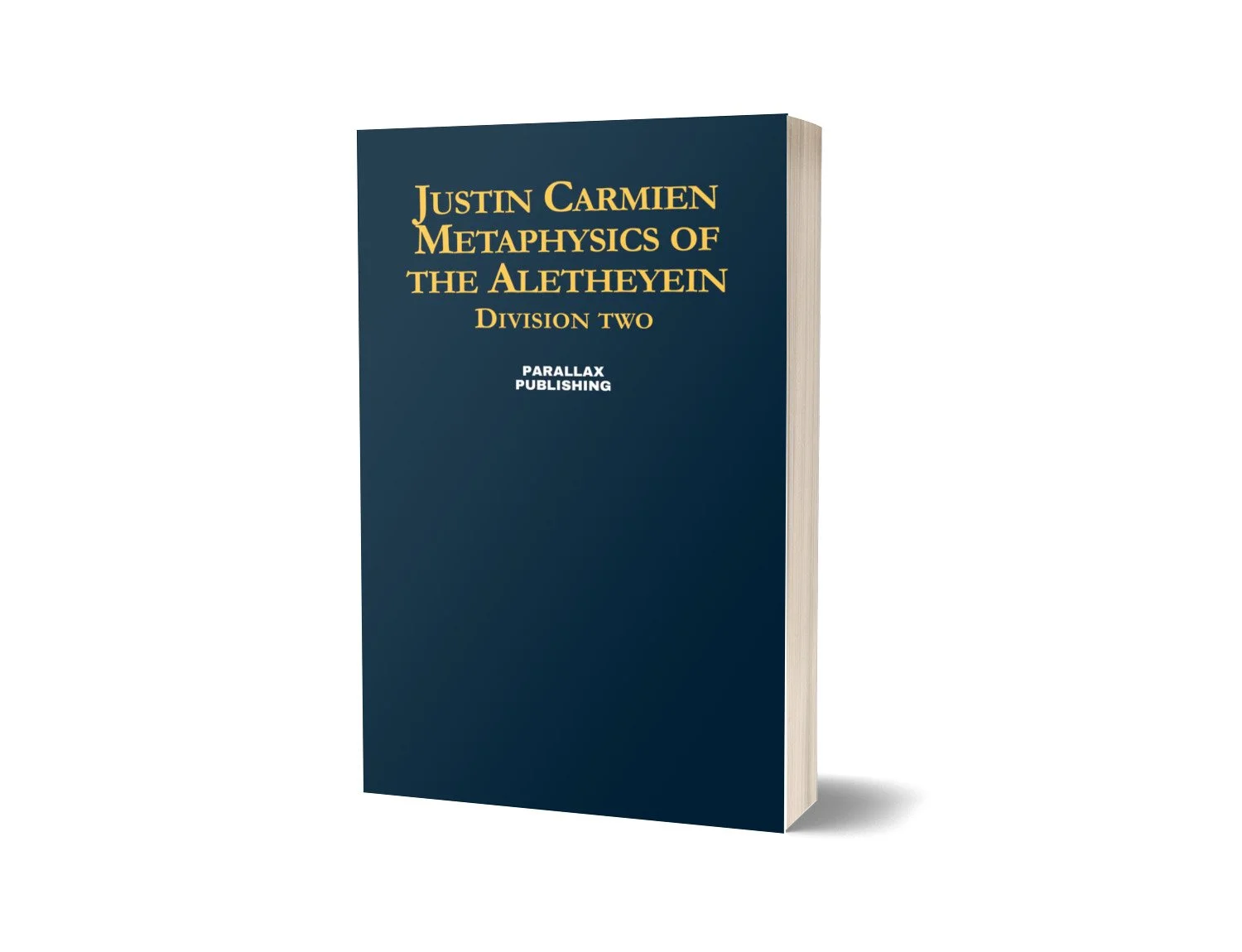
Justin Carmien: Metaphysics of the Aletheyein, Division Two
Philosophy
ISBN 978-13-990253-6-1
280 Pages, 13 x 20 cm, Paperback. €19,90
Release date: January15th, 2026
Introduction to First Economics Philosophy
The values which once drove modernization now exhibit clear signs of exhaustion. Throughout modern literature, we find widespread testament to alienation, rootlessness, estrangement, apathy, and resentment. “Metamodernism” is often presented as the successor to “postmodernism”, emerging after disenfranchisement, cynicism, and sarcasm have deconstructed the modern project. In this narrative, “metamodernity” appears in a generation’s attempt to reconstruct meaning following decades of cultural fragmentation, political exhaustion, and economic precarity. This reconstruction is typically framed as a personal or interpersonal endeavor: rediscovering purpose, retrieving narratives, and orienting ourselves toward the future with renewed sincerity. Perhaps the most persistent assumption in metamodern thought is that subjects—whether individuals or groups—anchor truth. Modern thinkers grounded truth in the autonomous individual; postmodern thinkers, in the interpretive community. Many metamodern accounts retain this dual inheritance, emphasizing personal development, emotional depth, identity, or belonging as central to metamodern transformation.
However, subjectivist metaphysics—whether individualistic or sociological—cannot adequately address modern failings.
Individuals do not generate truth solely from their interiority, nor can groups ground truth simply by invoking shared experience. Both perspectives assume a world in which subjects create meaning rather than encounter the truth disclosed through common mediums. Therefore, a metamodern philosophy appropriate for our era must be both post-subjectivist and post-sociological: subjects participate in truth’s disclosure, but they do not ground it. Only by returning truth to nature—so that we can experience our subjection to it—can we once again encounter objectivity. The task for metamodern economists is to study the conditions under which truth emerges, enabling us to encounter something resembling an “actual and authentic we”. Indeed, if the public sector of liberal political economy has become an empty shell, answerable to market interests; if the social sector delivers only identity politics, “tribalism”, and other forms of dissension within large heterogeneous populations; and if the private sphere’s attempts to compensate for these deficiencies have likewise failed, then we are directed to invest in an economy of truth.
This study—Metaphysics of the Aletheyein, Division Two: Introduction to First Economics Philosophy—explores the ethical and moral directives which arise in response to the crisis of modernity’s subject-oriented metaphysics. It reintroduces the concept of the “proiectum”, the architecture through which the truth manifests and is sustained as objective (Hegel). When applying the proiectum to organizational management and policy, we arrive at a “projectional goods economic theory”. The products of a projectional goods economy are “relational goods”—experienced as trust, confidence, and a felt sense of mutual thriving and flourishing. This work is designed for philosopher-activists committed to establishing an economy which actively produces relational goods for the actualization of the truth, for the benefit of the “possible we”, thereby conditioning encounters with the “actual and authentic we”. By activating opportunities for relational good production through a projectional goods model of government, we might begin to overcome the enduring symptoms of modernity’s prioritization of the “I” over the “you”: alienation, rootlessness, estrangement, apathy, and resentment.
Justin Carmien grew up in Northern Indiana, where his family has local roots. His great-grandfather, John Raber, ran for Congress in Indiana’s Second District in 1964, losing to then-House Minority Leader Charles Halleck. Following the campaign, Raber established Raber Golf, an 18-hole course located just outside Bristol, Indiana, which continues to be family-operated to this day.
As an adult, Justin began his career as an entrepreneur by founding a publishing company in the United States. He later relocated to Denmark to pursue opportunities in product design and marketing. While in Denmark, he partnered with Spinderihallerne—a municipal cultural and innovation hub located in the town of Vejle—where he hosted salons on philosophy in collaboration with international community developers.
In 2017, Justin launched a YouTube channel dedicated to exploring Scandinavian political philosophy, with a particular emphasis on the emerging metamodern movement. His videos garnered recognition for their thought-provoking insights and original reflections on contemporary thinkers, including the Russian political strategist Aleksandr Dugin.
Justin’s current studies further develop ideas from within the metamodern paradigm through what he refers to as "first economics philosophy”. Drawing on Martin Heidegger’s interpretations of Ancient Greek philosophy, this approach explores metaphysics as a foundation for value creation—one which encompasses both the phenomenon of the artist as well as the politician. He positions this philosophy as a “thinking space”, offering metaphysics as a response to the challenges of public life, particularly in the pursuit of truth and authenticity through policy and governance.
Justin currently serves as the president of his neighborhood association in Edgewater, Chicago. Justin is a contract designer for the Government Finance officers Association, a local government think tank based in Chicago.