
The Developmental Growth of Positive Primordial Emotions. With Terri O`Fallon
The Course begins Sun July 5th 8pm CET/ 12 pm MT
The
Growth of Primordial Emotions
with Terri O`Fallon
This course is not simply about “feeling better.” It is about cultivating the very capacities that shape how we perceive ourselves, others, and reality itself.
Most people assume emotions are fixed traits: you are either compassionate or not, grateful or not. But developmental psychology suggests something far more radical: emotions themselves can evolve. Love can become deeper, less possessive, more spacious. Compassion can mature from personal sympathy into an almost universal care. Gratitude can shift from momentary appreciation into a stable orientation toward life itself.
What makes this course unique is that it approaches emotions not merely therapeutically, but developmentally. Terri O’Fallon explores emotions as evolving structures of consciousness — capacities that can become more refined, more conscious, and more integrated over time.
At a moment in history marked by fragmentation, polarization, anxiety, and emotional reactivity, the ability to stabilize deeper forms of love, compassion, joy, and gratitude is no longer a luxury. It becomes a form of inner grounding and orientation — a “true North” that helps us remain human amid complexity.
The course combines developmental insight, meditation, direct experience, and interpersonal reflection. Participants do not merely discuss emotions intellectually; they learn to recognize their own developmental patterns experientially, and cultivate practices that can gradually transform everyday life.
In this sense, the course is both profoundly practical and deeply transformative:
not an escape from the world, but a way of becoming more present, resilient, and capable within it.

Course Content
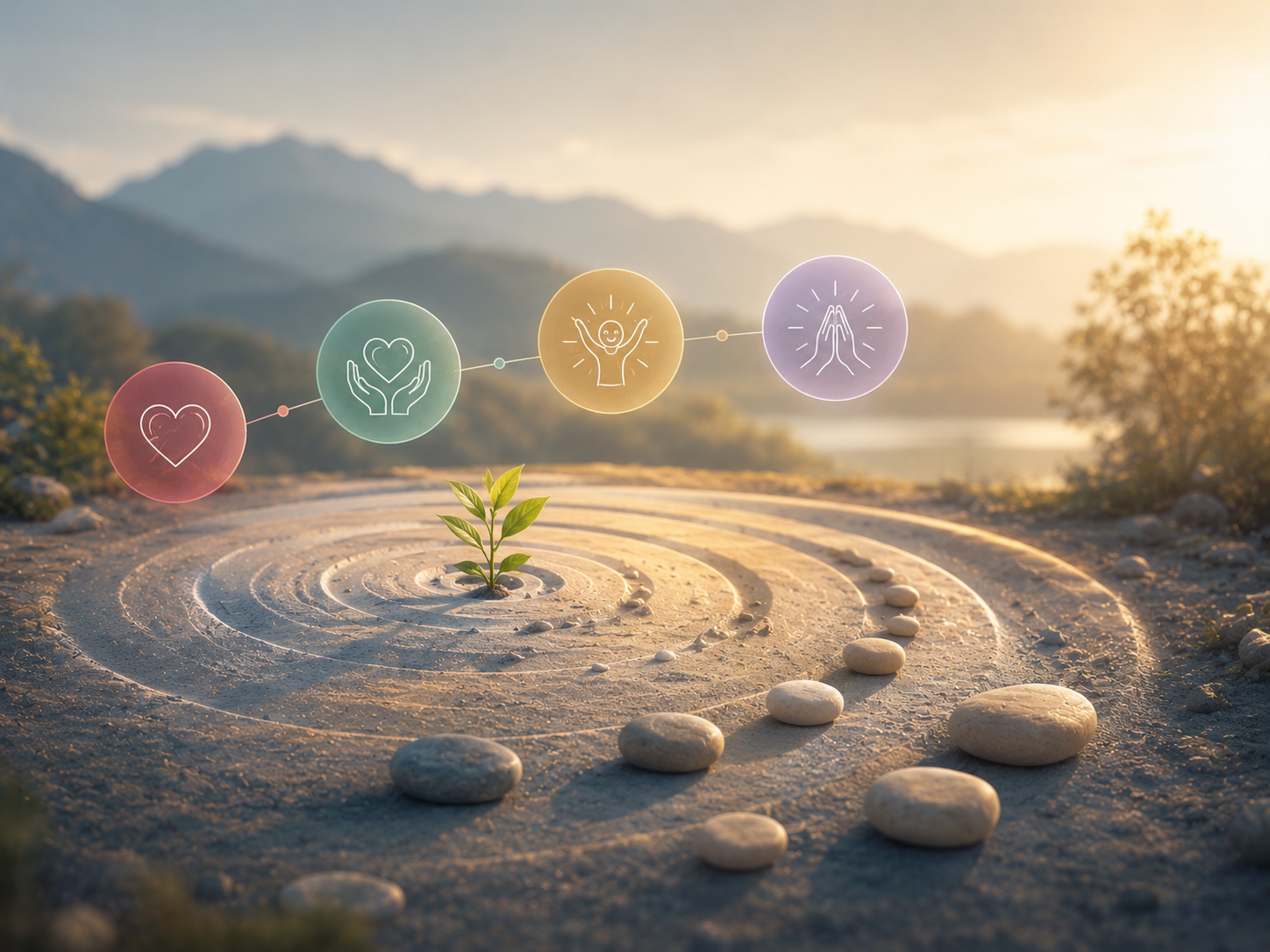
The four primordial emotions we will cover are, love, compassion, altruistic joy, and gratitude and they all have roughly the same developmental repeating pattern of growth. First they are concrete; then subtle; next MetAware, and finally can be experienced in a unified way.
Along with the developmental levels of the emotions, metacognition also develops. Metacognition is the reflector that helps one recognize one’s “true North. As these emotions develop and grow, a metacognitive reflector can watch, and notice/recognize if these emotions stay true or if they wander off into something else.
We will learn about each emotion; experience emotional meditations on each level for each emotion, and check ourselves with the metacognitive reflector. Next we will meet in small groups and reflect on our experiences and then share in full group. Then we will make a plan for meditation practice over the next week. m Over the four sessions, an aim and intention is to continuing ongoing positive emotional practices after the course. The meditations will be short enough that you can do one right after you wake up in the morning and set your day.
Session 1- Sun July 5th 8 PM CET
A. Introduction:
1. The STAGES Matrix and the repeating patterns of emotions.
2. The developmental structure of any emotion from concrete, to subtle to MetAware.
B. The developmental structure and experience of love: getting the picture
1. Understanding: What is love and how does it grow and develop?
2. A Love Practice: meditation they do and can have to listen to later
3. Break out groups to talk together about their experience of love:
C. Group discussion
a. what is their developmental love level?
b. How can they practice for what comes next?
c. Make a love development plan.
d. Homework: practice your plan during the week.
D. Q and A if time is left. Closure.
Session 2- Sun July 12th 8 PM CET
A. Introduction.: The developmental structure and experience of compassion: getting the picture
1. Understanding: What is compassion and how does it grow and develop?
2. A The developmental structure and experience of compassion: getting the picture
3. A Compassion Practice: meditation they experience and can have to listen to later
4. Break out groups to talk together about their experience of Compassion:
B. Group discussion
a. what is their developmental compassion level?
b. How can they practice for what comes next?
c. Make a compassion development plan.
d. Homework: practice your plan during the week.
C. Q and A if time is left. Closure
Session 3- Sun July 19th 8 PM CET
A. Introduction.: The developmental structure and experience of Altruistic Joy getting the picture
1. Understanding: What is Altruistic Joy and how does it grow and develop?
2. A The developmental structure and experience of Altruistic Joy: getting the picture
3. An Altruistic Joy Practice: meditation they experience and can have to listen to later
4. Break out groups to talk together about their experience of Altruistic Joy
B. Group discussion
a. what is their developmental Altruistic Joy level?
b. How can they practice for what comes next?
c. Make a Altruistic Joy development plan.
d. Homework: practice your plan during the week.
C. Q and A if time is left. Closure.
Session 4 - Sun July 26th 8 PM CET
A. Introduction.: The developmental structure and experience of Gratitude: getting the picture
1. Understanding: What is Gratitude: and how does it grow and develop?
2. A The developmental structure and experience of Gratitude: getting the picture
3. An Gratitude: Practice: meditation they experience and can have to listen to later
4. Break out groups to talk together about their experience of Gratitude:
B. Group discussion
a. what is their developmental Gratitude: level?
b. How can they practice for what comes next?
c. Make a Gratitude: development plan.
d. Homework: practice your plan during the week.
C. Q and A if time is left. Closure.

TICKETS

About your facilitator
Terri has lived enough life to appreciate her own tarnished halo. Life has polished her rather than worn her out. With six siblings, Terri literally grew up in the “Little House on the Prairie” lifestyle on a small family farm in central Montana-receiving the blessing of having actual experience with a world that was a generation before her time.
She received a BS in Education, teaching in one-room country schools for several years before completing her MS in Special Education. She started and led an organization that served developmentally disabled adults that served four Montana communities. Terri went on to receive certification in public school administration, which included superintendents, principals, and special educational administration certificates at which time she served as a school superintendent for five years, and an elementary school principal for 8 years. With the completion of her PhD she went on to teach at the colleges and university level.
Terri has been teaching now for over 60 years. Her life’s purpose seems to be culminating in her work with the STAGES model. Its scoring system is derived from Wilber’s quadrant polar pairs, integrated with the Ego development research of Jane Loevinger and adapted by Bill Torbert and Susanne Cook Greuter.
STAGES reveals intriguing possibilities: understanding the relationship between states and stages; pointing to collective evolutionary patterns; recognizing the role of the senses in the evolution of perception and perspectives; developmental grammar and semiotics; repeating patterns; and the place in our development for concrete, subtle and metaware objects. There is much room for exploration and prototyping, including matching practices to developmental stages.
Terri now lives in a tiny town in central Montana close to her siblings, has two sons, a daughter-in-law and two granddaughters. She loves to take long walks every day, ride her bike and contemplate how to develop the listening skills her mother had; though now passed away, “she is still raising me.”
Website: STAGESInternational.com