
A Case Against Humanism— the Ethics of the Aletheyein
There is a peculiar moral reflex I often encounter at precisely the moments when something meaningful might occur—a move too-quickly towards reconciliation. What first appears as divergence is soon drawn into a movement of apology or clarification. The conversation orients itself toward points of convergence. When these are found, the interaction gains momentum; and when they are not, a subtle pressure emerges to move past the difficulty. Of course, this moral reflex might be described as belonging to the very constitution of the human animal. We “code-switch” instinctively. Yet, I resist this diagnosis and suspect that what presents itself as a timeless feature of the condition of the human animal is, in fact, historically intensified—even weaponized—within the context of our political economy.
Within secular liberalism, otherness appears as a temporary inconvenience: a gap to be closed as efficiently as possible. When we encounter religions, languages, experiences, or worldviews which diverge from our own, the prevailing instinct is not to dwell in the tension of the encounter but to translate it into familiarity. “Jesus is a prophet in Islam,” the Muslim tells me. “Scientific skepticism is simply mature childlike wonder,” the atheist reassures us. Whatever the word “evil” might signify, we are encouraged to understand it as merely an experience awaiting reinterpretation. In these gestures, edges are softened. We convince ourselves that beneath visible differences lies an underlying sameness. This sameness is not biological, sociological, or historical. It is metaphysical.
We call this metaphysical position humanism.
Humanism resolves difference by moving upward. It abstracts from the specificity of time and place in order to locate a stable ethical ground. In this upward movement, difference is translated into universality. Tension is relieved by inclusion within a shared category—human being. We step back from the contingency of the moment—including the material and economic asymmetries which structure it—and reassure ourselves that understanding has already been secured. I call this intellectual solution to the problem of difference the ethics of episteme: an ethics grounded in knowledge-forms which seek to resolve tension through abstraction.
There is, however, another ethical movement—one which does not ascend towards abstraction but descends into the conditions which have made the moment possible. Indeed, the moment itself is constituted by the announcement of a shared space in which a “you” and a “me” now stand in relation to one another. This downward movement does not dissolve difference. It intensifies our exposure to it.
I have come to think of the opening in which difference occurs as the Aletheyein—not a concept to be applied, but an event to which we are subjected whenever a relation has become actual. Within this opening, truth does not belong to a “you” or a “me”, but to the condition which allows both to stand in relation. This subjection is an experience which, in the social realm, could only be experienced as a fetish. However, in the domain of the natural, subjection is a liberation. Our shared and natural subjection to the common presences not only the past which has converged us, but also the primordial future—that which is still-outstanding. In the metaphysics of the Aletheyein, the “then when such-and-such is the case” precedes the “now that such-and-such is the case”. The future possibility of the situation is prior to its present recognition. The moment is always oriented towards what is yet to be decided. Thus, the ethical directive is less about recognizing ourselves in others than about remaining faithful to the possibilities which emerge in the encounter itself. To remain within and subjected to the Aletheyein is to resist the premature closure offered by universal categories. It is to accept that coexistence cannot be guaranteed in advance, and that the meaning of a relation might only become clear through its unfolding.
Historically, the ethics of episteme has carried political consequences. Early modern European universalism, grounded in metaphysics of Reason and Human Rights, accompanied projects of colonial expansion. Universal categories enabled distant governance by standardizing difference. Long before exported externally, Napoleonic expansion transformed the German territories into early sites of universalist political reorganization, where abstract legal equality arrived as an instrument of external power. Yet, the universal did not merely include; because it carries its own subjectivity, it also apprehends, reorganizes, and in this process, subordinates the Other. This ethical movement can be traced through the Latin language, back to Roman imperialism.
The ethics of the Aletheyein belongs to a different lineage—one which might be called pagan in the sense that it remains bound to place, event, and unfolding natural circumstance. It displaces human being from its privileged position, and returns it to nature. Adherence to the Aletheyein is, in a psychological sense, experienced as a disposition of wonder towards the foreign. For those of us following the ethics of the Aletheyein, we respect the Other as the Other, allow it to stand for what it is—as something which affronts us, unreconcilable with the Self. It is something not to be dissolved, appropriated, equated with the Self, or phenomenally obliterated.
As the complexity thinker Bonnitta Roy has observed, novelty emerges at the fault line of difference.
To refuse universalization, then, is not to reject coexistence. It is to take coexistence seriously enough to examine the conditions under which it becomes possible. This is not a comfortable position. It offers no guarantee that our moment will remain joined into the future. Indeed, the truth of an encounter might sometimes be that divergence is necessary. Yet even this revelation can be meaningful if it emerges from a shared fidelity to the moment of the truth, rather than from the imposition of predetermined obligations.
I recognize our moment as one of reorganization and reconstitution. Thus, an ethics of the Aletheyein is necessary. Our task is to not close the opening too quickly, but to remain within it long enough for something genuinely new to appear.
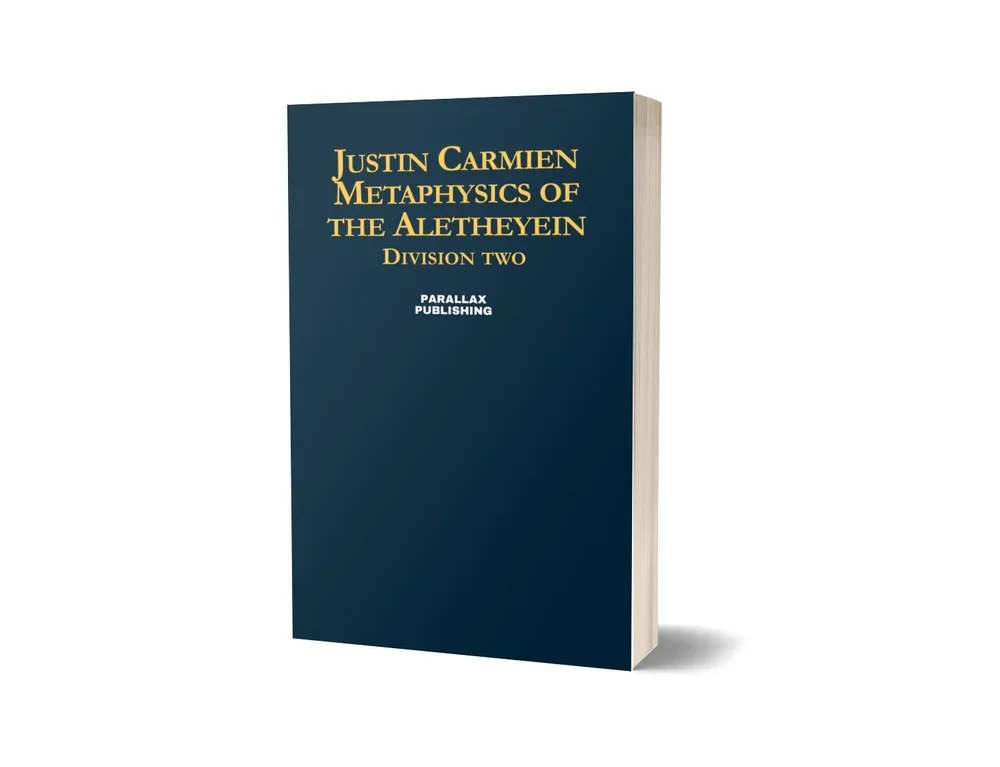
OUT NOW
METAPHYSICS OF THE ALETHEYEIN: DIVISION TWO - INTRODUCTION TO FIRST ECONOMICS PHILOSOPHY
Justin Carmien is the author of the book Metaphysics of the Aletheyein, Div One & Two. He currently serves as the president of his neighborhood association in Edgewater, Chicago.