
Beyond Enlightened Anthropocentrism
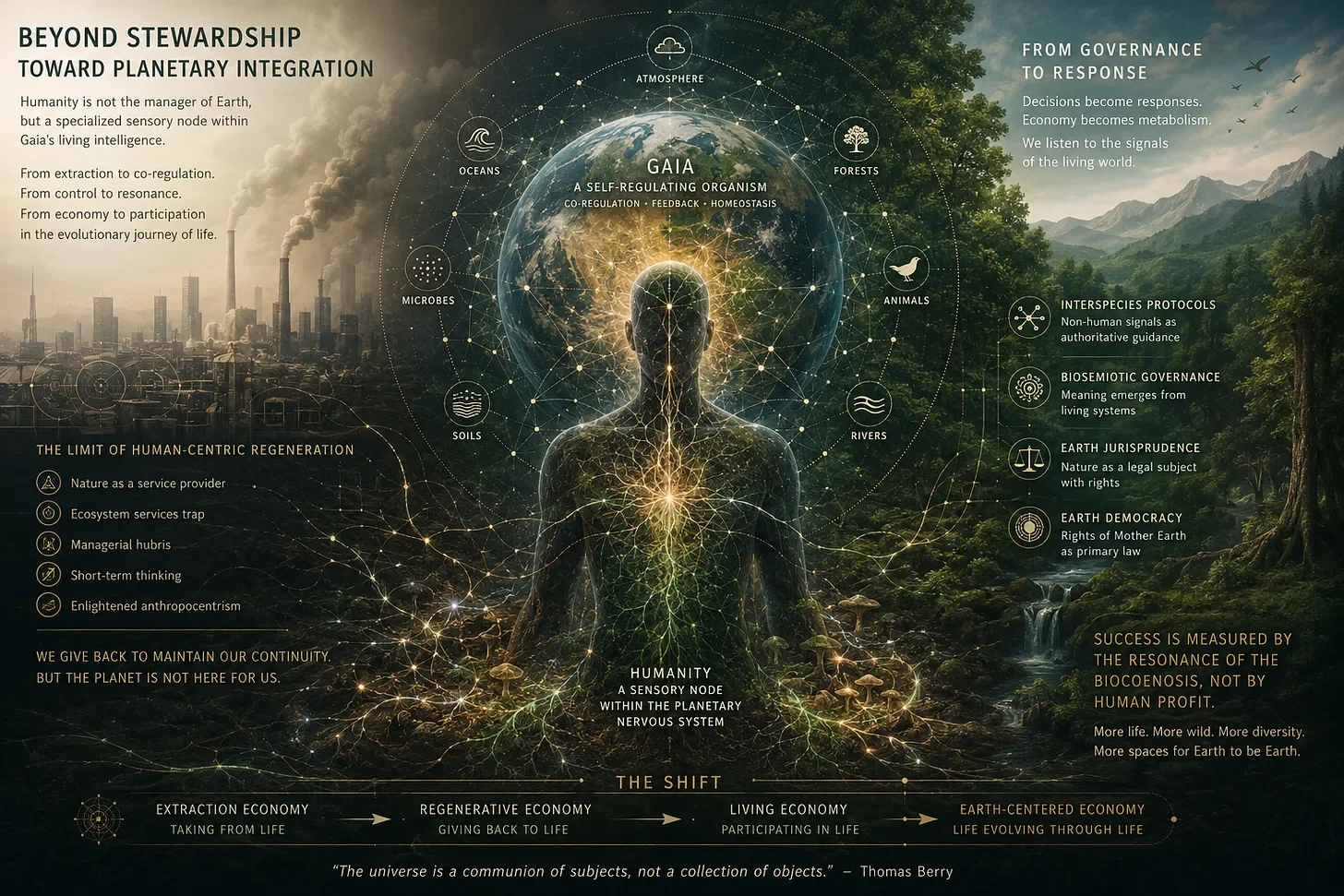
Regeneration, Nervous Systems, and the Limits of Human-Centered Economics
From Stewardship to Planetary Integration: Rethinking Regeneration Beyond Human Centrality : Part 2
By Cordula Frei
(For previous essays by Cordula Frei, visit our Substack)
This essay continues as Part 2 of an inquiry into the limits of contemporary regenerative and system-change thinking by questioning whether even its most advanced forms still remain anchored in anthropocentric assumptions. It explores the possibility that economic systems, governance models, and ecological frameworks are not only structural arrangements, but expressions of deeper perceptual and neurobiological dynamics through which humans relate to the living world.
The intention is not to dismiss regenerative movements, but to deepen the conversation toward a more radical threshold—where transformation is no longer only about redesigning systems, but about re-examining the embodied and evolutionary conditions through which systems themselves are perceived and reproduced.
The most common and significant critique of “human-centered” regenerative models—particularly those emerging from Western cooperative and systems-thinking traditions—is that they often remain within what can be called an “enlightened anthropocentrism,” where the language of ecological repair, regeneration, and reciprocity still quietly preserves the assumption that humanity is the primary subject of meaning, governance, and planetary care.
Contemporary regenerative frameworks undoubtedly represent an important departure from extractive industrial logics. They seek to move beyond sustainability—understood as maintaining a degraded status quo—toward regeneration, understood as actively restoring ecological and social systems. In this view, economies are reoriented toward healing soil, rebuilding ecosystems, strengthening communities, and improving human wellbeing. Yet despite this expanded ethical horizon, a structural continuity often remains: Nature is still largely framed as something that is managed, improved, or restored for the sake of human continuity.
This becomes visible in the widespread use of concepts such as ecosystem services, circular economy design, or regenerative value creation, where forests, rivers, soils, and biodiversity are translated into functional contributions to human survival and flourishing. Even when the intention is restorative, the underlying grammar often remains unchanged: the Earth is still legible primarily through its usefulness to human systems.
What changes is not necessarily the ontological position of humanity, but the moral refinement of its managerial role.
The core tension here is subtle but fundamental. Many regenerative models operate on the principle that humanity must “give back more than it takes,” implying a form of ecological balance sheet where extraction is still permissible as long as it is compensated through restoration, redistribution, or regeneration elsewhere. Yet this logic still preserves a transactional relationship with the living world, where nature is something from which value is taken and later returned in modified form. The deeper question is not whether this is more ethical than industrial capitalism—it clearly is—but whether it still rests on the same ontological separation between human systems and planetary life.
At this point, my critique moves from economics into epistemology and even perception itself. Because what appears as “system change” may still presuppose a human subject capable of standing outside the system, observing it, and redesigning it through conscious intervention. Yet systems are not only external structures; they are continuously co-produced through embodied cognition, emotional regulation, and deeply embedded survival patterns within the human nervous system.
From an evolutionary perspective, this becomes even more significant. Mammalian nervous systems evolved not for planetary governance, but for survival within immediate environments—organizing perception through rapid threat detection, attachment regulation, and resource optimization. In primates, social order is continuously negotiated through neurobiological states of safety, dominance, bonding, and exclusion, long before they become cultural or institutional structures. What we later describe as “society” or “economy” may therefore be deeply shaped by these underlying regulatory architectures.
In this sense, modern civilization can be understood as an extension of survival-based nervous system logic operating under conditions of extreme complexity.
Economic systems, political institutions, and cultural narratives may function in part as large-scale externalizations of biological strategies for managing uncertainty, stabilizing identity, and regulating collective stress. Even regenerative paradigms may not escape this dynamic, but instead represent a more sophisticated adaptation of the same underlying imperative: to preserve continuity in the face of ecological and systemic instability.
This raises a more radical possibility: that “system change” discourse, while structurally important, may remain incomplete if it does not account for the biological and perceptual conditions through which systems are perceived and reproduced in the first place.
A system is not only designed—it is inhabited, stabilized, and continuously reenacted through states of attention, arousal, and embodied meaning-making.
The regenerative vision currently stands at a decisive turning point. On one side, it seeks to move beyond sustainability toward active ecological restoration, cooperative governance, and localized resilience. On the other, it risks remaining within a refined form of anthropocentric stewardship, where humans are still the central designers and managers of planetary health. The question is whether this model truly decouples from human centrality or simply rebrands it in more ecologically sensitive language.
This becomes especially visible in models that integrate “holistic balance sheets,” where human wellbeing, ecological health, and social cohesion are treated as interconnected value domains. While this represents an important expansion beyond narrow profit metrics, it can still imply that the Earth is meaningful primarily insofar as it contributes to human flourishing. Nature becomes integrated into a more sophisticated accounting system, but remains structurally positioned within it.
A deeper critique therefore emerges: even regenerative economics may still operate within what could be called a managerial ontology, where humans remain the organizing intelligence responsible for optimizing planetary systems.
Yet ecosystems do not function through managerial intention. They self-organize through distributed, non-linear, multi-species interactions that exceed cognitive control and planning. Forests are not designed. Rivers are not optimized. Evolution is not governed.
From this perspective, the notion of “enlightened anthropocentrism” becomes a central limitation. Even when regeneration is framed as healing rather than extraction, it often still asks: how can we manage the Earth more wisely?
It rarely asks whether management itself is the appropriate relationship between humans and the living world.
A more radical shift would move from stewardship to planetary integration, where humanity is understood not as external manager but as a specialized sensory expression within a larger self-regulating planetary system. In continuity with the work of James Lovelock and Lynn Margulis, the Earth can be understood as a living, self-regulating organism—Gaia—within which humans function as one localized nervous and metabolic component rather than an external governing intelligence.
In this framing, order is not imposed on Earth by human systems; it emerges through co-regulation across species, ecosystems, and material flows. Humanity does not “bring” order to nature, but participates in its ongoing relational stability. The Earth is not a system to be managed, but a living process of which we are already a part.
To make this shift operational, governance itself would need to transform. Instead of top-down decision-making based primarily on human economic indicators, one could imagine Interspecies Protocols where non-human signals—soil microbiome dynamics, fungal networks, migratory patterns, hydrological cycles—are treated not as secondary data, but as authoritative expressions of planetary regulation.
This implies a movement toward what could be described as Biosemiotic Governance, where economic and political decisions are no longer framed as isolated acts of human rationality, but as responses within a distributed sensory field of life. In such a model, meaning is not exclusively produced through human language and policy, but through the continuous interpretation of living signals across ecological systems.
Success in such a framework would no longer be measured by profit, efficiency, or even sustainability, but by systemic resonance within the biocoenosis—the living community of interdependent organisms.
Any subsystem that attempts to dominate or decouple itself from this relational field risks triggering systemic instability at larger scales, not as moral punishment, but as ecological feedback collapse within a tightly coupled living system.
At this point, regenerative economics intersects with deeper philosophical traditions such as Earth Jurisprudence and Earth Democracy, where legal and ethical frameworks begin to recognize rivers, forests, and ecosystems as subjects rather than objects. In such a shift, nature is no longer a managed resource but a community of living intelligences with intrinsic rights independent of human utility.
Yet even here, a further question remains unresolved: is this simply an expansion of human ethical consideration, or a genuine decentering of the human as the primary locus of value?
This is where the nervous system dimension becomes unavoidable again. Because the human nervous system evolved under conditions that rewarded control, prediction, territorial regulation, and survival optimization. Civilization may therefore be an expression of deeply embedded biological strategies that continue to shape even our most advanced ecological thinking. Regeneration itself may be part of this adaptive arc—a way for complex systems to preserve continuity under conditions of ecological breakdown without relinquishing underlying control structures.
If this is the case, then the limitation of regenerative economics is not primarily conceptual but embodied. It may not be enough to redesign systems if the perceiving organism remains structured around separation, control, and survival-based cognition.
At the outer edge of this inquiry, regeneration is no longer only an economic or ecological project, but a question of consciousness itself, whether human beings can continue to experience themselves as external managers of Earth systems, or whether a deeper shift is required in which perception itself reorganizes around relational embeddedness within a living planetary process.
The deeper question therefore becomes: can consciousness itself move beyond the survival-based architectures that produced civilization as we know it, or does every attempt at regeneration ultimately remain shaped by the ancient biological imperative to stabilize uncertainty through the reorganization of the world around human continuity?
Author’s Closing Note
This essay emerges from a life lived at the edges of what modern systems tend to call “productive” or “connected,” but what I experience more accurately as a gradual return to a slower, more relational form of existence—one shaped by wilderness, by off-grid rhythms, and by daily communion with animals, weather, soil, and the quiet intelligence of non-human life and by my own crises and journey.
In this environment, questions about economy, systems, and regeneration do not remain abstract. They are continuously tested by immediacy: by what the land can hold, by what the body can sustain, by what animals communicate without language, and by the subtle feedback of ecosystems that respond not to theory, but to presence. Over time, this dissolves many of the conceptual separations that modern discourse tends to rely upon—between human and nature, observer and system, intention and consequence.
What becomes increasingly difficult to sustain, in such a lived context, is the idea that life can be meaningfully organized from a position of externality. The more time one spends in direct relationship with living systems, the less convincing it becomes to imagine nature as something that is managed, optimized, or even “helped” from outside. Instead, what remains is participation—sometimes harmonious, sometimes fragile, always reciprocal, and never fully controllable.
From this place, the language of regeneration itself begins to shift. It is no longer primarily a theory of systems or a model of improvement, but a question of attunement: how to remain sufficiently quiet, receptive, and responsive to what is already alive and unfolding beyond human design. The wilderness does not require validation through human frameworks; it continuously reorganizes itself according to logics that predate and exceed our concepts of value, economy, or governance.
If there is a conclusion, it is not an answer but a deepening of attention. A recognition that any meaningful transition—ecological, economic, or civilizational—may ultimately depend less on the sophistication of our systems, and more on our capacity to re-enter relationship with life in a way that does not immediately translate it into control, utility, or abstraction.
More than anything, this work is written from within that ongoing practice of listening—of living close enough to the land, the animals, and the rhythms of the non-human world that theory is constantly asked to become humble again in the presence of what it cannot fully capture.