
What is Will? – Part 14: On Camus
By Tom Amarque
(For previous essays on will, visit our Substack)
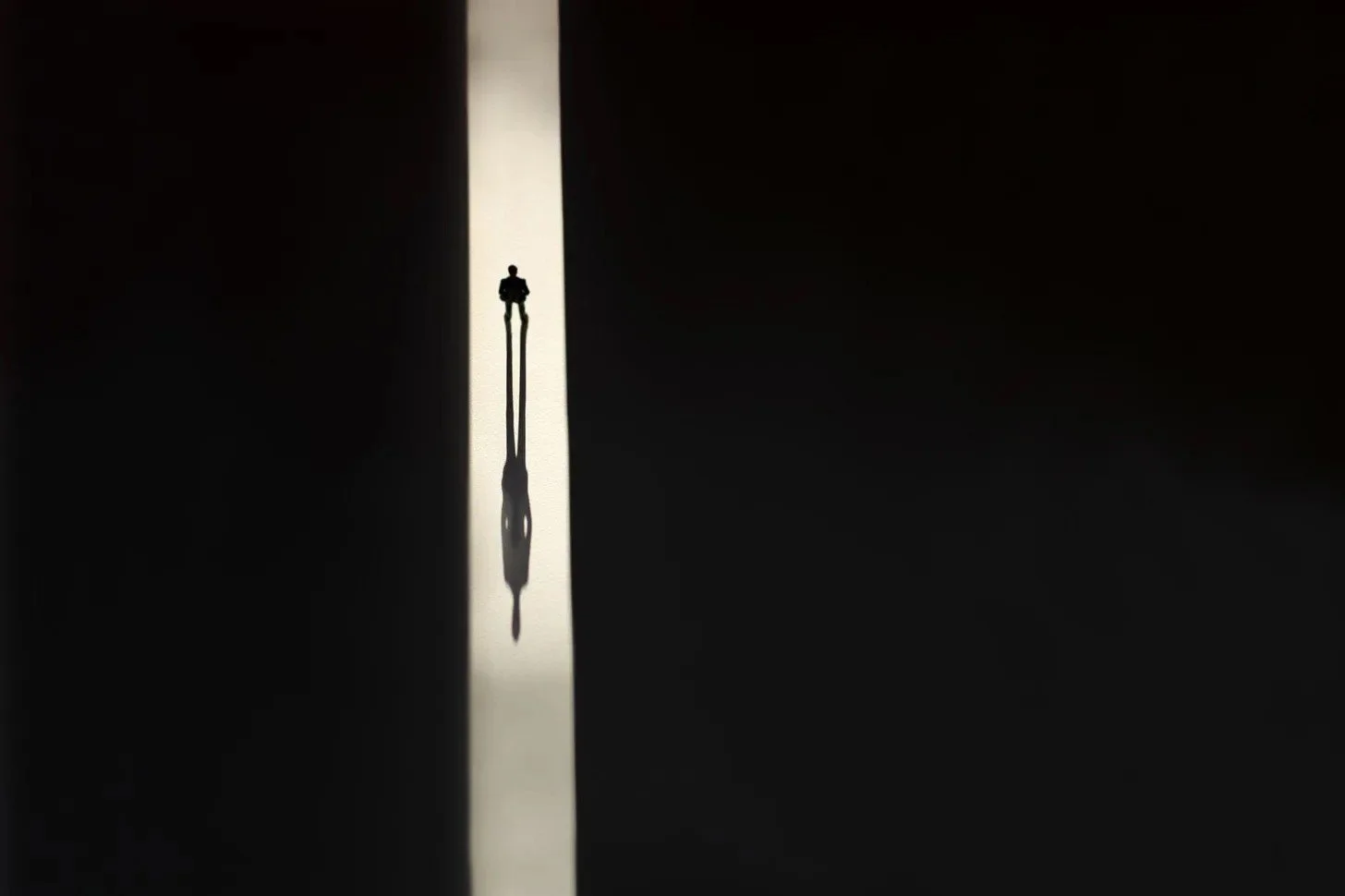
Meursault was cool. Not in a performative way, but genuinely cool. He didn’t need to perform his coolness, as is so common today (and that’s not real coolness). He exhibited a kind of indifference and detachment, as if he didn’t quite belong to this world. If he were to describe himself, it would be in a mild, observational tone. He was brutally honest with himself and others, and felt no need to perform emotions for society. Precisely for that reason, he could afford to be honest.
Some argue that he might have been autistic, though that’s unclear. Still, in hindsight it suggests that real coolness and autism may not be as far apart as one might think. He reacted to major events in his life with the same “zero fucks given” attitude as to minor ones, largely indifferent to social conventions and anchored in the present. Even when his mother died, he remained (un)naturally calm—much to the distress of those around him. In their eyes, something was off. He was, in a sense, too cool for them—and that became his downfall.
Meursault also had a very peculiar outlook on life. Although somewhat alienated, women were drawn to him—and to his coolness. The more he “kept his frame”, as we say today, and told his fiancée that he would probably marry any woman if asked, the more she seemed to want him. He didn’t play along or give in to her expectations.
For the same reason, he wasn’t particularly ambitious. Being overly ambitious isn´t cool, you know? He didn’t care much about money or career, things that matter a lot in todays world. He had no passions and, in our context, no identifiable mission or goal or will. When his boss once asked if he wanted a better job and a different life, he replied that one life is as good as another—there is no real difference. We are all born, we all die, and in between we play more or less the same games.
Later, when pressed to explain his view more clearly, he put it like this: toutes les vies se valent. All lives are equal—in their ultimate indifference. Death levels everything. Choices, ambitions, loves, individual lives, carrers, adventoures, ‘travels’—they are, in the end, interchangeable. We all share the same fate. Everything will be soon forgotten. Even humanity itself.
In this sense, he felt that the world is meaningless. We seek meaning, but the universe does not provide one. And it was this underlying stance that lead to the murder. When asked why he shot the Arab, he answered truthfully: because it was hot that day, and the sun had irritated his eyes. There was no deeper reason. And because the jury believed him, they had to sentence him to death. Through his actions, he had questioned everything that they build to avoid the meaninglessness of existence. It even seemed that the judge seemed more preoccupied with the fact that he didn´t mourn the death of his mother properly as with killing the Arab.
But ultimately, something weird happened in the final hours before Meursaults death. For the first time in his life, he felt at home in the universe, because his inner detachment and coolness, and the meaninglessness of the world, finally found a symmetry, and he was deeply content and just wished that more people could hate him while he died.
*
When Albert Camus wrote The Stranger in 1942—a work that contributed to his receiving the Nobel Prize in Literature in 1957—World War II was at its zenith. Paris was still occupied by the Germanz. Tens of thousands of soldiers died in Stalingrad that same summer. If there had ever been a time of Kairos, of massive cultural upheaval and death, it was right then. The old world quite literally died. And in this darkness, writing that novel, Camus laid the groundwork for what would later (in the coming 30 years) be recognized as postmodern sensibilities. Everything—from the meaninglessness and absurdity of existence, to the erosion of “modern” societal norms and values and narratives, to the radical cultural relativity of perspectives and life choices (you can be anything, even change your genitalia), to the prevalence of nihilism, to the aimless drifiting and the aversion to will, to the pop-cultural phenomenon of “cool” (or even a kind of stylized detachment), embodied by figures like Marlon Brando, Lou Reed, or David Bowie—and even more recent phenomena such as the “manosphere”—can be read as encoded here, can be found memetically embedded here. (Note that Mersaults cousin, Raskolnikow, was neither postmodern nor was he cool in any sense of the meaning; but Raskolinkov at least thought he had a reason to kill). If you feel that there is no essential difference between male and female, that biology offers no meaningful explanation of life, if you feel you live in a ‘meaning-crisis’ and a time of kairos and the senseless evil of mens deeds (patriarchy! inherently toxic masculinity!), you are still living inside of this seminal novel.
To be postmodern is to inhabit a crisis of meaning. That is its very essence. There is no absolute truth, no absolute meaning, outside of your cognitive apparatus, even if you are enchanted with evolution and development and spirituality. With these stories we tell ourselves, we make meaning to us in the sea of darkness. And if one wishes to move beyond this condition, it must be felt to the bone. You can´t brush over the kernel of truth of postmodernism. And one cannot, as Albert Camus later makes clear, find a solution in suicide or in “leaps of faith”—that is, in religious hope, because it is just another way to obstruct the realization of the coldness and darkness and meaninglessness of your existence. There is no escape. What remains, according to Camus, what can take the place of resolution, is only revolt: to live fully while lucidly acknowledging the absurdity of existence.
Much has been said about post-postmodern, metamodern, performative, and integral movements—attempts to overcome the postmodern condition. Because, after all, it is not a good place to live in. It feels like Paris in 1942. Some of these approaches that offer remedy are purely rational; others are religious or spiritual; still others are performative, or just venture shamelessly into the capitalist business-realm (hello, Spiral Dynamics!). But all of them miss, to some degree, a crucial point: postmodernity cannot be overcome by an act of thinking or analysis alone. It must first be fully acknowledged, fully felt, and truly encountered. And only out of the depth of that realization—out of a direct encounter with the kernel of truth within that episteme—can something new begin to emerge.
And what one discovers then is a sort of purified will—unassuaged by purpose, freed from the craving for results: Life itself. A will that no longer seeks justification in outcomes or tries to evade the darkness, but affirms itself, affirms life, in the very act of willing. It is the light after the war. It approaches what psychiatrist Viktor Frankl, contemporary of Camus, called the “will to meaning,” while at the same time echoing Friedrich Nietzsche’s affirmation of the will to power.
And then it is felt. And it is felt in joy, in unbridled optimism, in absolute meaning. Everything else, every story and theory and ethics, comes ofter this realization, as only every postmodern theory from the Frankfurt School to Lypotard to Foucault, emerged after the felt experience of 1942. You have to feel and experience it first. Then you can model it.
So remember: When people talk about the meta-crisis or meaning crisis, what they really say is that they are still stuck in the aimless vortex of postmodern story. They do not feel anything. They don´t know what to do, have neither vision nor mission, and complaining and whining about the crisis have always been the ugly sisters of despair. Rather do something and something with enthusiasm, than do nothing and complain.
*
There is a large ethical elephant in the room—one whose outline we are only beginning to perceive, some eighty years after the publication of The Stranger. Meursault had no obvious reason to kill the Arab. He simply reacted—because it was hot, because the sun irritated his eyes. In that sense, he appears to lack agency. He becomes, almost literally, an example of the philosophical stance that there is no free will.
We have discussed the problem of free will elsewhere. Here, it is enough to note that numerous studies and lines of inquiry suggest that some notion of free will is ethically necessary for a functioning society. If there is no free will, then no one is responsible for anything. Like Meursault, everyone would merely be reacting involuntarily to circumstances. Without responsibility, society begins to unravel. Accountability is a precondition for any stable social order. Even scholars who deny the existence of free will acknowledge that some notion of it is necessary for society to function.
And indeed, what we are seeing ever more clearly in 2026 is a growing capture by a postmodern, nihilistic stance that denies free will. This manifests, for example, in tendencies to interpret violent acts less in terms of responsibility and more in terms of pathology or structural causation (Inversely to the story, we treat Islamist knife killers in Germany in a way to rather send them to mental hospitals than to prison) The underlying logic is consistent: if there is no free will, then everyone is primarily a victim—of social forces, systemic pressures, or historical injustices.
Whether the focus is on different identity groups, political communities, or even broader anxieties about climate change or artificial intelligence, the ethical pattern remains the same. The central issue is responsibility: without it, moral judgment becomes unstable, and the foundations of accountability and society at large begin to erode. Thats where we are right now. It doesn’t matter if it’s trans-people or women or Jews, or Palestinians or Afro-Americans or white men (as being framed nowadays as being victims of toxic feminism) or the enlightened spiritual community as victims of climate change, AI, Trump and whatnot: you can´t act if you view yourself a victim. And if you can´t act it´s as if you have never lived.
Tom Amarque is writer, philosopher, podcast host, editor & publisher. His recent book is ‘Phenomenology of will’. He founded the German publishing house Phänomen-Verlag in 2009 and Parallax-Media in 2019. Tom currently lives in Palma, Spain. Contact him a tomamarque@yahoo.de