
Everybody Wants to Be Closer to Free: A Modern Artifact
There is a particular jingle which still hums through grocery stores and banks, a faint residue of another world. “Everybody wants to be closer to free.” This sentiment once announced itself as self-evident, hardly resonating as a virtue, but rather as background music—something which was absorbed while pushing a shopping cart, waiting in line, and swiping a credit card. It was first popularized as the title track of the American TV drama, Party of Five. However, what strikes us today is not that this sentiment has been rejected, but that it simply no longer resonates. Like many moral slogans of late-stage liberalism, it survives as an artifact, long after its force has dissipated. The question, then, is not why we abandoned the value of freedom, but why it has ceased to be sufficient.
For most of my early life, the value of freedom served as the highest good. It presupposed an individual subject capable of making something meaningful of its freedom. To be free was to be unbound, self-expressive, and self-determining. It was to be the artist of one’s own life—both internal and authentic. In contrast, constraint was assumed to be external and oppressive. But this dichotomy depended on an increasingly fragile anthropology. Indeed, it can be argued that late-stage liberalism is principally characterized by fragmentation, where freedom is less often experienced as possibility and more often as exposure to incoherence—and, in the most extreme cases, a threat to personal safety. Perhaps like me, you have heard expressions of “too much liberalism”. But what we find today is not the emergence of a simple return to authority (though we do hear that sentiment too), but a renewed willingness to speak about one’s subjection—that is, a subjection to ideals, disciplines, practices, and forms of life which exceed the self. This shift is visible in places where we might least expect it. While survey data continues to show declining religious affiliation, spiritual testimony has become culturally legible again. Public expressions of faith were once treated as embarrassing relics, but now circulate freely. People listen attentively when others speak of devotion and obedience. It has become permissible to say that one submits to something more meaningful than personal preference.
Of course, it is tempting to interpret this cultural shift as a reassertion of monotheism, as though exhaustion from liberal freedom naturally resolves as a renewed commitment to a sovereign truth. Yet, this diagnosis moves too hastily. Monotheism is not merely belief in one god. It is a totalizing structure in which revelation is unified, authority is centralized, and contradiction is addressed through hierarchy. Moreover, liberal tolerance cannot perform a reconciliation of its multicultural world without dissolving the very claims which it seeks to preserve. One cannot simply “accept” the absolute authority of the Christian God, the Muslim God, and other monotheistic deities simultaneously without hollowing each doctrine out from within. Indeed, coexistence is the liberal treatment of the political problem of relative truth—but it is a solution which I can only experience as nihilistic. Yet, this does not mean that I have suffered. Another possibility has emerged—one which I describe as polytheism. It is a worldview rarely understood with sufficient care.
Polytheism does not mean that all gods are equally true, nor does it imply a cheerful and naïve pluralism in which every belief harmoniously coexists in an “interfaith” space. In fact, polytheism does not reconcile doctrines at all. Instead, polytheism describes a disposition. It refers to the capacity to encounter truth as something which arrives from many messengers without demanding synthesis or final adjudication. The phenomenon of the artist might provide a useful example. Artistic inspiration rarely announces itself from a single source. Rather, it emerges from nature, recollection, tradition, conflict, and by accident. These sources are not reconciled into a unified authority—certainly not by some object we call the Self. Instead, they are held in tension along with their internal contradictions. The artistic work is always outstanding. Moreover, this disposition establishes a relation to the disclosure of others. Thus, the disposition is political: one need not affirm the truth of another’s idols in order to listen attentively to what has been revealed through their devotion.
In my work, this orientation has been shaped by sustained engagement with what I now described as the aletheyein. It is not a personal deity, but names the god which embodies revelation itself. In the Greek sense, aletheia (“truth”) is not righteousness, correctness, or correspondence, but the showing. We might remember that Ancient Greek thea means “view”. Theoros means “spectator” and is related to Modern English theatre and theory, but also to theos, which we translate as “god”. Importantly, Ancient Greek aletheia includes in it both the revelation of the true and the false, moral and immoral.
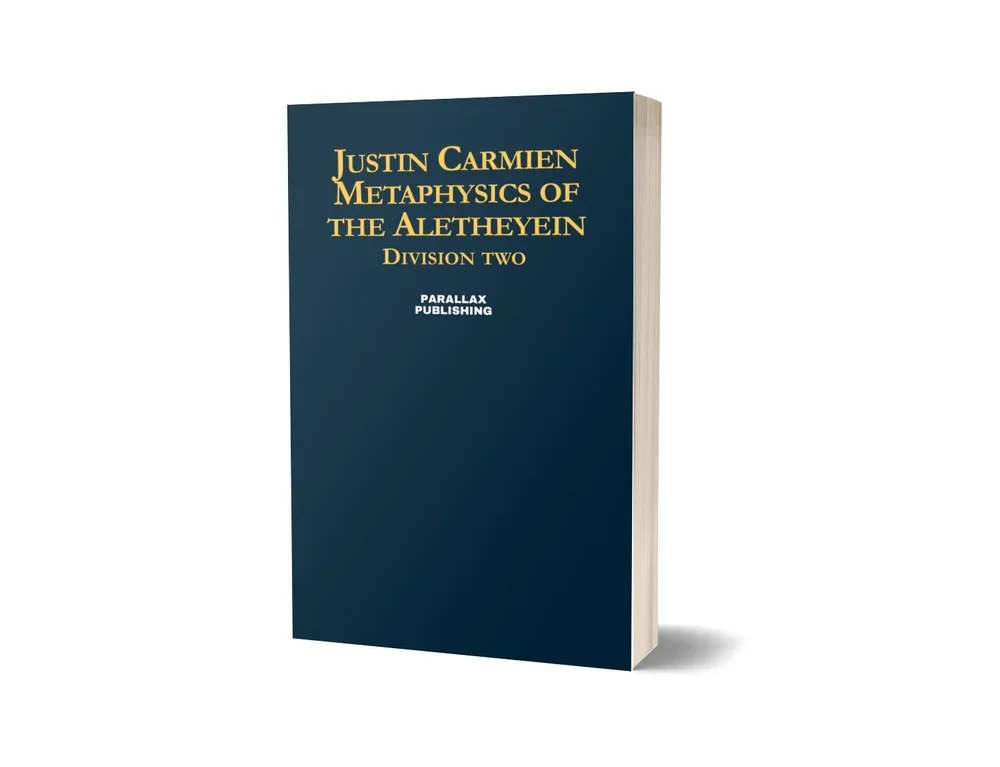
OUT NOW
METAPHYSICS OF THE ALETHEYEIN: DIVISION TWO - INTRODUCTION TO FIRST ECONOMICS PHILOSOPHY
In the last century, Martin Heidegger flirted with Ancient Greek paganism when he described aletheia as unconcealment. Heidegger’s works describe a post-subjectivist condition—a horizontal clearing devoid of vertical hierarchies. Among the many modern vertical virtue hierarchies, we must include American pragmatism, as well as the truth of the industrialized sciences—which, not to be mistaken, demands that the phenomenal experience conform to a hypothesis. That is to say, nature must conform to a standard of “man”. Such standards are employed to domesticate nature, producing a totality which we call the uni-verse (literally, that which has been turned into one). Thus, to think of truth as revelation is to abandon both modernity’s absolute truth and postmodernity’s relative truth. That is, metamodern truth is neither imposed from above nor “socially constructed”. Rather, the experience of truth today is one which has been released from the domain of “man” and returned to nature, emerging within nature’s relationships—among human animals, but also increasingly among non-human animals, machines, intelligent programs, and every other phenomenon which can be objectified from our environment. A relational understanding of truth means that if any one particular were removed from the relational context, then the truth sustained through that relationship would also be lost.
Thus, if truth is indeed relational, then it requires a god capable of opening rather than commanding—a god which presides over revelation without owning it. Such a figure does not arbitrate competing claims; it makes space for their showing. This space includes encounters with religious traditions, of course—but it also includes revelations which arrive from places we have been taught to disregard. Nature speaks, but so does technology. Today, I am presented with technology which must be displaced from its designation as “artificial” and returned to nature—something which is independent of me, such that it can show itself of itself. Technology shows itself as prior to me. Thus, technology demands that we confront the potentially uncomfortable truth that we have never abandoned the practice of fetishism—only, we must now reclaim a healthy relationship with it. Fetishism is natural. I assume artists will understand me.
For myself, the apparent turn away from freedom and toward subjection is not a regression. Instead, it is a response to the limits of a moral framework which can no longer sustain. What my friends, colleagues, and lovers seek is not liberation from all constraints, but orientation within a world which speaks from many directions. Polytheism names this condition without pretending to reconcile tensions in response to the “metacrisis” or in the name of “progress”. Such reconciliations follow the modern practice of positioning “man” at the center of the world as its conqueror and domesticator.
The books I am offering you are an attempt to think seriously within this space. There is a possibility of devotion without domination and truth without totality. And certainly, plurality is possible without liberalism’s hollowed-out nihilism of “coexistence”. For those who follow my thought, you understand that this position quickly becomes political. However, my work does not ask the reader to believe—indeed, “do you believe in god?” is the wrong question. That question centers the individual. Rather, the political program which follows from the aletheyein centers the object as a common medium, providing a clearing for the showing of truth in the relationships between the you and the me, but also between those phenomena which do not conform to the morphology of the human animal.
Justin Carmien is the author of the book Metaphysics of the Aletheyein. He currently serves as the president of his neighborhood association in Edgewater, Chicago, and works as a designer for the Government Finance Officers Association, a local government think tank based in Chicago.