
The Adult as a Metaphysical Category
I fear that something adult has quietly gone missing from my social experience. I’m not so much worried about a loss of discipline among my friends and colleagues—certainly not authority, nor responsibility—but about something which precludes such virtues and makes them possible. Therefore, it is also something potentially more elusive. Specifically, I refer to the capacity to bear an object which is not tantamount to the Self. That is, the capacity to stand before an object—whether a work of art, a story, or even the truth—and allow it to remain other, irreducible to one’s identity. What appears to have replaced this capacity is not immaturity, but something more truncated: a social condition of perpetual adolescence. In this perpetuation, the subject increasingly becomes the primary location of truth. Thus, the object—once something endured as that which is still outstanding—has collapsed into the spectacle of the Moment.
Before writing books in philosophy, I spent nearly a decade working as a graphic designer and design manager at LEGO. Prior to that, I worked as an illustrator in the comic book industry. I do not invoke this history autobiographically, but diagnostically. Indeed, cosplay (“costume play”) serves here only as a case example of the shift from object-orientation to subject-orientation. Of course, cosplay is often defended as creative—and as a craft, it is. But continuing with metaphysical terminology, it marks the point at which the distance between subject and object collapses. This is where my departure from the comic book industry becomes intelligible. I did not leave because of prudishness—though I did feel uncomfortable at times. I left because the work was no longer asking anything of the subject. The economy shifted from interpretation to attention—and attention, unlike truth, demands nothing of the Self: it is already coincident with it. This is why I refer to subject-oriented economies as adolescent—not because they are playful or embodied, but because they cannot tolerate exteriority. Everything must be absorbed into the subject. The sports-team fan included. Yet, this shift in the location of value has not been confined to the arts and entertainment industries. Indeed, it is perhaps most pronounced in the US political economy. Here, I find much of our political discourse operating in an infantilized stasis: slogans replace arguments, identity replaces judgement, and moral standing is conferred not through sustained contact with truth but through the expression of righteousness. In such a stasis, disagreement appears not as a conflict of claims about the world, but as a personal injury inflicted upon the Self. This diagnosis is important: once the authority of the object disappears, authority itself becomes intelligible primarily as oppression. This distinction is required in order to address the suffering within our current political stasis. Indeed, if nothing outside the Self can make a claim upon us, then every demand appears coercive and every standard tyrannical. Yet genuine authority is not characterized by domination of the Self, but by the reception of the object—the power by which the object summons us beyond ourselves and into adulthood.
In many historic economies, the work stood between creator and audience as a third thing: something still outstanding and capable of outliving both. This mediating role of the object is foundational to the philosophy of G. W. F. Hegel, for example. An object-oriented philosophy insists that the world is not primarily composed of perspectives and identities, but of objects which ask us to reckon with them and endure their internal tensions. Truth presents the most striking case. I invoke the adult as the metaphysical category describing that which is capable of truth—and, in its capacity, it is also the one which bears it. Thus, I do not use the word “adult” biologically, referring to human animals who have reached a certain age. Rather, the adult is the location which exhibits the capacity for truth—or, more precisely, the capacity for its reception and the bearing of the truth. In my published books, I have developed the word afference for this capacity. It derives from the Latin ad- meaning “to, towards” and ferro meaning “to carry, bear”. It is not a “personal faculty” reserved for the phenomenon of the human animal, but to any object bearing the tensions of the outstanding.
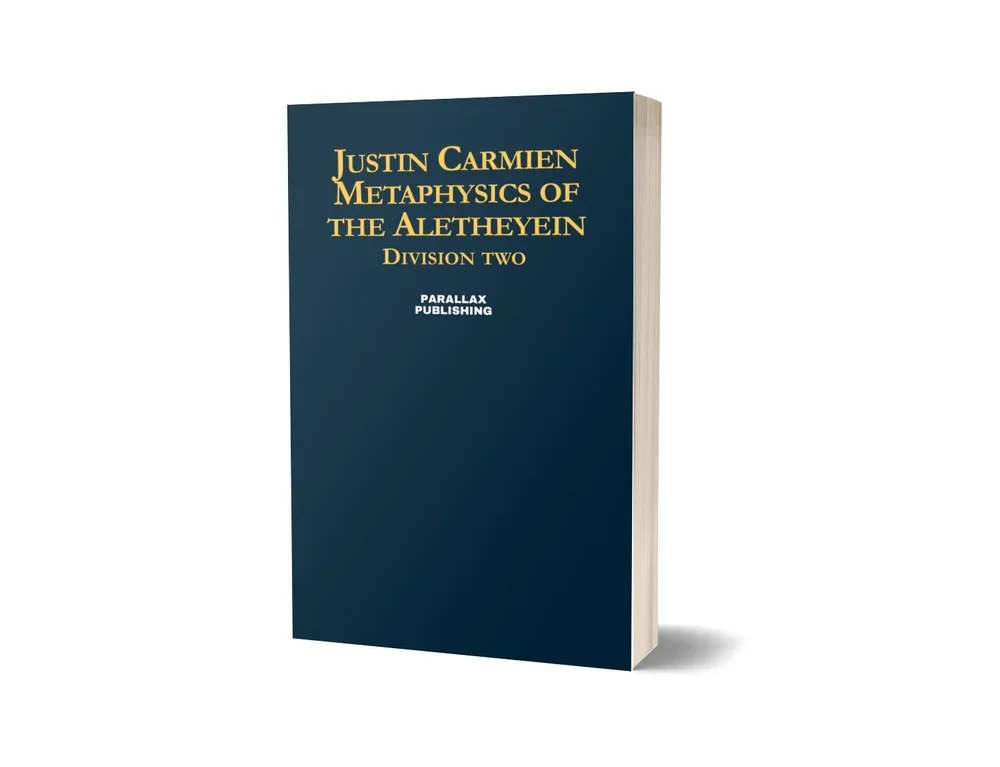
OUT NOW
METAPHYSICS OF THE ALETHEYEIN: DIVISION TWO - INTRODUCTION TO FIRST ECONOMICS PHILOSOPHY
What Comes After Adolescence?
We often imagine that adulthood is a biological state which must be cultivated through domestication—through rules, hierarchies, or norms. But adulthood—as a metaphysical stasis—cannot be imposed. It must be called forth by objects worthy of being shown. If I derive any ethical response from this reflection, then it must be this: not to suppress play or embodiment, but appreciate that which is distant: reassert the existence of objects which do not immediately resolve into identity. To allow truth to remain something which shows itself of its own volition—in my works, I call this volition the aletheyein.
And while this reflection might read as a lament, or a mere cultural criticism which evokes metaphysical terms for mere “intellectualism”, it also serves to acquaint you with my past and the tradition which inspired it. This history might help you to appreciate the trajectory which has led to the creation of The Metaphysics of the Aletheyein. After all, it is true: I do express fatigue with virtue and righteousness—both centering the Self—and often treated through psychology, sociology, and self-domestication—that is, spiritually. If my words resonate with you, and your social experience has also become saturated with Selves, the most radical act we might take is to restore the object. I understand this to be the orienting move of what I have elsewhere called first economics philosophy.
First economics philosophy does not problematize individuals and their capacities or deficiencies, but approaches our social, political, and economic problems through object-orientation reflection. This thinking space offers respite from the common diagnostic methods which seem to have only exacerbated our contemporary personal, social, and political challenges. It does so by problematizing value creation itself and, more explicitly, our failure to satisfactorily generate objects of value within a post-liberal or metamodern form of life.
Justin Carmien is the author of the book Metaphysics of the Aletheyein. He currently serves as the president of his neighborhood association in Edgewater, Chicago, and works as a designer for the Government Finance Officers Association, a local government think tank based in Chicago.